⚔️ Enter Board
⚡ Comparison 📖 Book Edition / PDF Español (ES)

Modern War Chess

A War Game for Peace

The system you hold in your hands today is the pinnacle of strategic evolution. What was physically concluded in 1981 as the visionary concept of creator Federico Díaz (originally played in the Dominican Republic on an asymmetrical 8x9 wooden board under the name "Gueides"), has undergone a profound architectural, mathematical, and digital re-engineering process by Oscar Camino. By eradicating the ambiguities of traditional chess and introducing an absolute axis of symmetry governed by pure code, the game engine evolved into its definitive form on a perfect 9x9 plane.

The Legend of Two Eras

Legend has it that the original chess was created for the Indian king Sheram (or Belkib), with the sole purpose of curing his profound boredom. Today, history repeats itself. In an era where hyper-analyzed openings have led the greatest contemporary genius to express his boredom with traditional chess, Modern War Chess is born as the answer to that same need for innovation.

We have named our algorithmic standard in honor of the Latin term "Magnus" (The Great). A historical bridge that connects the tactical brilliance of the ancient Roman general Gnaeus Pompeius Magnus with the modern genius of Magnus Carlsen, who deeply inspired us during the design of this new battlefield.

The Algorithmic Standard

A Living, Evolving Ecosystem

Modern War Chess is not a static product; it is a constantly growing technological and competitive ecosystem. We are open to listening to proposals and considering collective alliances. We are in a phase of global expansion, ready to continue scaling through new commercial partnerships (including tech industry giants), the entry of strategic investing partners, Grandmasters, and elite developers who wish to pioneer and participate in the future of mind sports.

Tactical Evolution

Discover how the classic concepts of chess have mutated into precision tactical weaponry. A perfect transition for Grandmasters.

📡

The Golden Rule: The Radar

Before analyzing the pieces, you must understand the supreme rule of Modern War Chess. The Radar is an electronic defense unit with no equivalent in chess. At the beginning of the game, it is a critical piece that must be protected at all costs, because as long as it is alive, it inhibits the flight of enemy aerial pieces (Drones and Missiles). However, once the opposing Drone and Missile have been eliminated, the Radar mutates and becomes a valuable attack piece to hunt down the enemy.
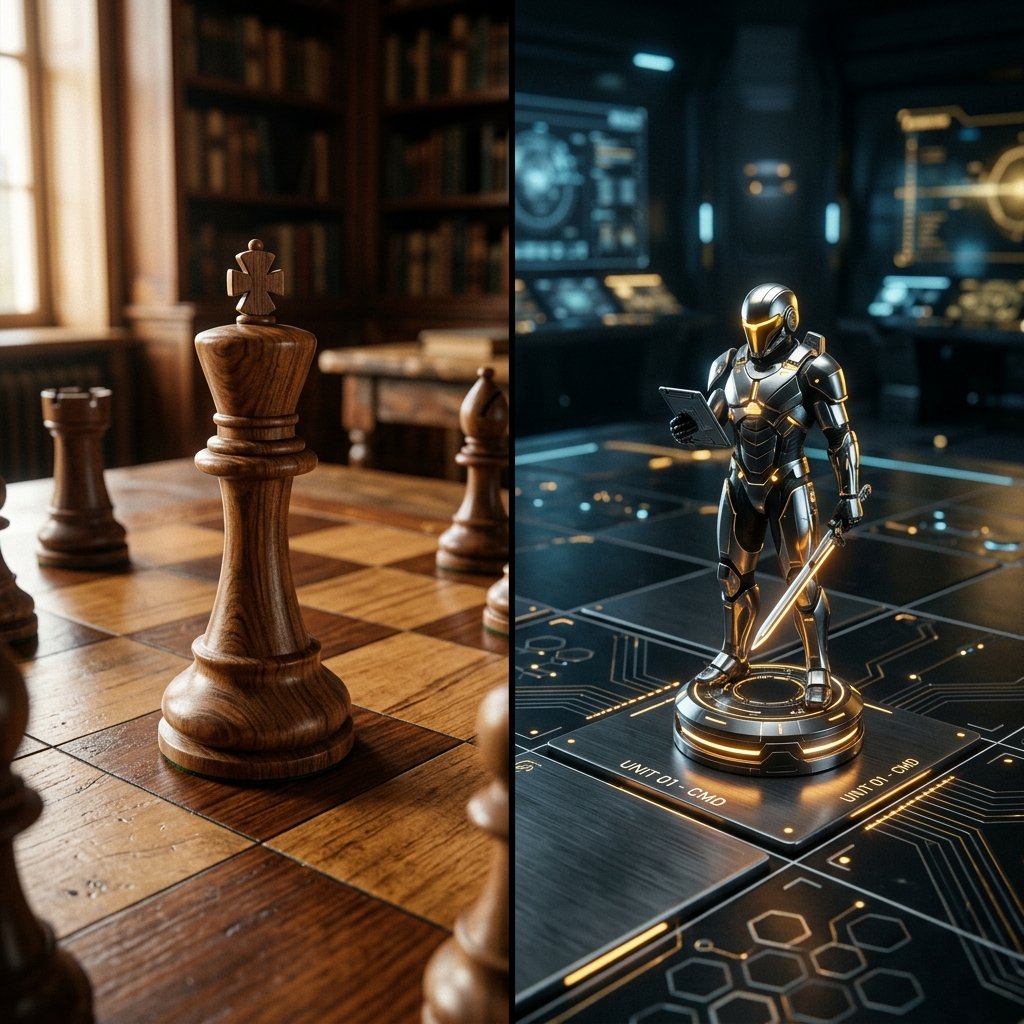
King vs Commander

Classic Chess

♔ King

Moves one square in any direction. Can perform "Castling" only once to seek protection behind the rook, in a static maneuver.

Modern War Chess

🎖️ Commander

Moves one square in any direction. Instead of castling, he possesses the lethal "Bunker Jump": a tactical 2-square horizontal jump (even over pieces) that can be used defensively or offensively to capture, as long as he is within his territory (ranks 1 to 4).
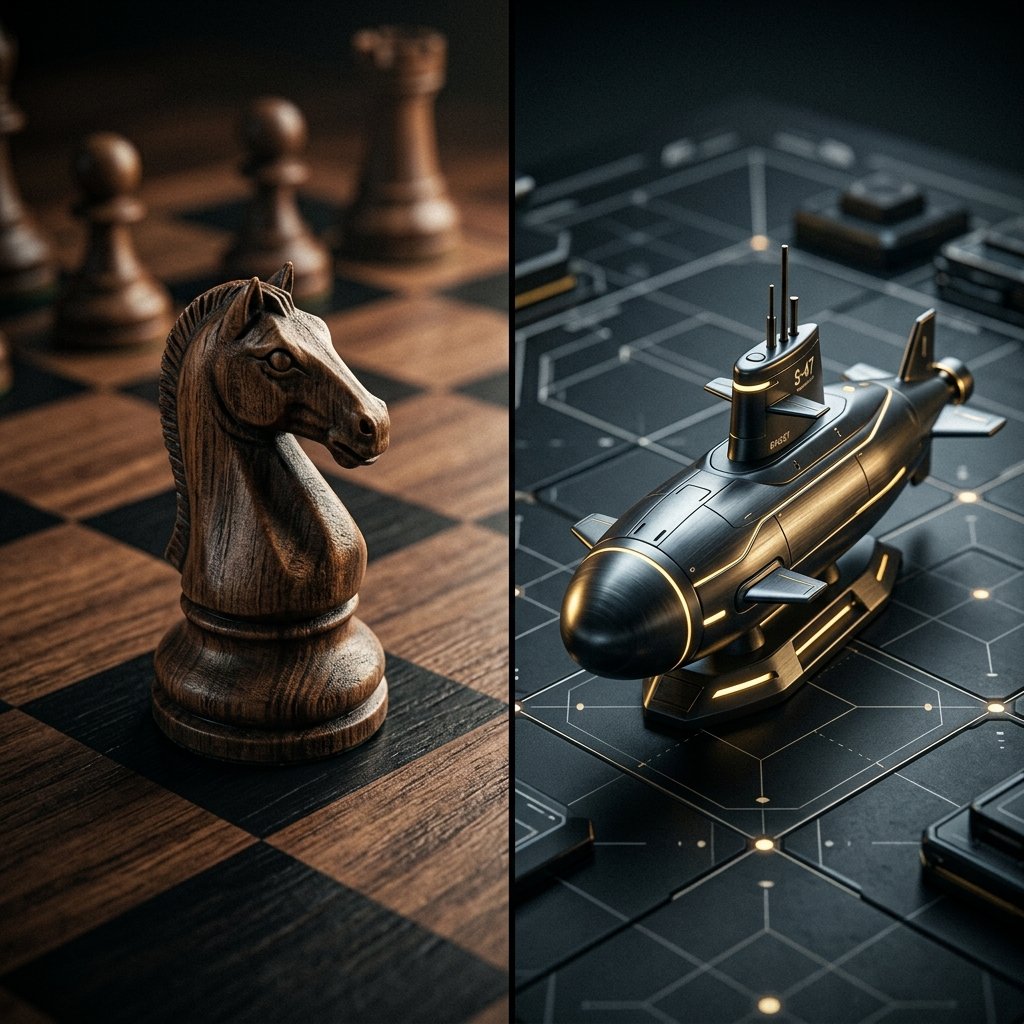
Knight vs Submarine

Classic Chess

♘ Knight

The only piece that can jump. Moves in an "L" shape (two steps in one direction and one perpendicular).

Modern War Chess

⚓ Submarine

Its base movement consists of 1 vertical or horizontal step, followed by 1 diagonal step (similar to the classic knight jump). To this, it adds a unique power: Immersion. In the opening, it can submerge to pass under an allied Infantry. Furthermore, it has a tactical retreat of 2 diagonal steps backwards, allowing it to attack and disappear into the depths on its next turn.

♕ QUEEN
VS
🛸 DRONE

Both have infinite reach in all 8 directions. The lethal difference: if the enemy Radar is destroyed, the Drone ascends and flies over both enemy and allied pieces. This allows it to threaten with Guebel or Guebel Mortis (Checkmate) via "X-Rays" through other units, turning it into an extermination machine, provided the heavy armor of a Tank or Battleship doesn't intervene.

♖ ROOK
VS
🛡️ TANK / BATTLESHIP

They maintain infinite rectilinear movement. Their key evolution: in Modern War Chess, these pieces act as a "Physical Shield". Neither Drones nor Missiles can fly over them, even if the Radar has fallen. They protect the structural integrity of the fleet.

♙ PAWN
VS
🪖 INFANTRY

They advance the same way (1 or 2 steps initially, then 1) and capture on the forward diagonals. Unlike the chess pawn, the "En Passant" rule has been eradicated to purify the mathematical algorithm. Also, if your Radar has been eliminated, you can choose to promote an Infantry to a Radar. This is an optional promotion that will depend on your positional analysis, being crucial if the enemy Missile and Drone are still active on the battlefield.

♗ BISHOP
VS
✈️ STEALTH JET

Moves on dark diagonals like a Bishop, but breaks barriers with its "Re-adjustment Flight". NOTE: The Jet NEVER flies over pieces during its diagonal run. It can only overcome obstacles by exclusively using its re-adjustment flight (2 squares vertically or horizontally), which allows it to tactically reposition and surprise the enemy.

The Tactical Hybrids (No pure equivalent)

🚀 Missile (Bishop + Vertical Rook)

Infinite diagonal and vertical movement. Its vertical advance allows it to change the color of its diagonal at will. It gains flight capability when the enemy Radar falls, being able to threaten via "X-Ray" just like the Drone.

🛳️ Aircraft Carrier (Horizontal Rook + Bishop)

Infinite diagonal and horizontal movement. Its horizontal sweep allows it to adjust its diagonal lines of attack. It doesn't fly, but it controls the width of the battlefront with terrifying dominance.

Advanced Theory and Tactics

The Value Curve of the Stealth Jet

In Modern War Chess, the value of the pieces mutates drastically according to the phase of the game. At the beginning of the match, the Stealth Jet is statistically more powerful than the Tank and the Battleship. Its re-adjustment flights allow it to land and form a lethal "defensive barrier" that controls the center and threatens multiple squares. However, in the endgame (barring positional exceptions), being tied exclusively to dark diagonals, it becomes clumsy at combining with the Commander to hunt down an enemy leader sheltered on light squares, yielding its supremacy to heavier pieces.

The Hunting Net: Offensive "Bunker Jump"

The Commander's "Bunker Jump" is not just an escape tool (like castling). In advanced endgames, if the allied Commander still retains this jump and the enemy Commander penetrates his territory, the hunting power multiplies. Taking advantage of the jump's greater lateral reach in his own zone, the allied Commander can work in tandem with a Drone to close off all escape lines. The Bunker Jump acts as the final move of the cornering net to execute a flawless Guebel Mortis.

Tactical Reach Simulator

Select a piece and click on the board to reposition it. Evaluate how its strength and territorial control change depending on its geometric location.

Tactical Observation Exercises

Try these instructions on the board above to visually understand the deeper mechanics of the game: